

Key Takeaways
- A water line leak usually shows up first as a higher water bill, low pressure across the whole house, or a soggy patch of yard, long before you ever see water.
- In Kansas City you own the service line from the curb stop to your house, so a leak on that side is your responsibility to repair, not the city’s.
- You can confirm a hidden water line leak in a few minutes with a simple water meter test, no tools required.
- Older KC homes often run galvanized steel lines that corrode from the inside, a leading cause of leaks and fading pressure.
- A small spot repair runs a few hundred dollars, while a full replacement runs from about $3,200 trenchless to $16,000 or more by open trench.
- Shut your main valve, avoid digging blindly, and call a licensed plumber. Most homeowner policies do not cover wear-and-tear pipe failures.
A water line leak is one of the most expensive problems a Kansas City home can hide, and the earliest signs of a water line leak are easy to miss. If your water bill jumped with no change in how much you use, your pressure dropped at several fixtures at once, or a patch of yard stays soggy or oddly green in dry weather, you may already have a water line leak running underground.
Here is the short version. Confirm the water line leak with a simple water meter test, figure out whether it sits on your side of the curb stop, which it usually does and makes it your bill to fix, then call a licensed plumber before a slow drip becomes a burst main. The rest of this guide covers every warning sign, what causes a water line leak in Kansas City, how to tell what your line is made of, and what a repair or full replacement really costs.
Water Main vs. Your Service Line: What You Own and Who Pays
Before you deal with a water line leak, it helps to know what you actually own. People use water main, main water line, and water service line to mean the same thing, but they are not the same. The water main is the large city pipe under the street. Your water service line is the smaller pipe that branches off it and carries water into your house.
Ownership splits at the curb stop, a small underground valve near the property line or sidewalk. In Kansas City, KC Water owns the line from the main to the curb stop, and the property owner owns the private service line from the curb stop into the house. So who is responsible for the water line on your side of that valve? You are, which means a water line leak on the private portion is yours to repair and pay for. That one fact catches more homeowners off guard than anything else here.
| Section of line | Who owns it | Who pays to fix it |
|---|---|---|
| Water main under the street | KC Water (city) | City |
| Main to the curb stop | KC Water (city) | City |
| Curb stop to your house | You, the owner | You |
On many older Kansas City lots the curb stop sits a foot or two inside the sidewalk, so a water line leak right at that valve often surfaces in the strip between the sidewalk and the street rather than in your yard. That fools people into thinking it is the city’s problem when the private side is theirs.
This split matters for two reasons. First, a water line leak on the private side is money out of your pocket, and most homeowner insurance treats a worn-out pipe as maintenance rather than a covered loss. Second, the meter keeps running while the leak does, so the longer it goes unconfirmed, the bigger the bill. Acting early is the cheapest version of this problem.
Signs of a Water Line Leak
A water line leak underground rarely announces itself. It starts small, hides under the yard or the slab, and usually turns up first on your bill or in your water pressure. These are the signs of a water line leak that Kansas City homeowners run into most, and what each one is telling you.
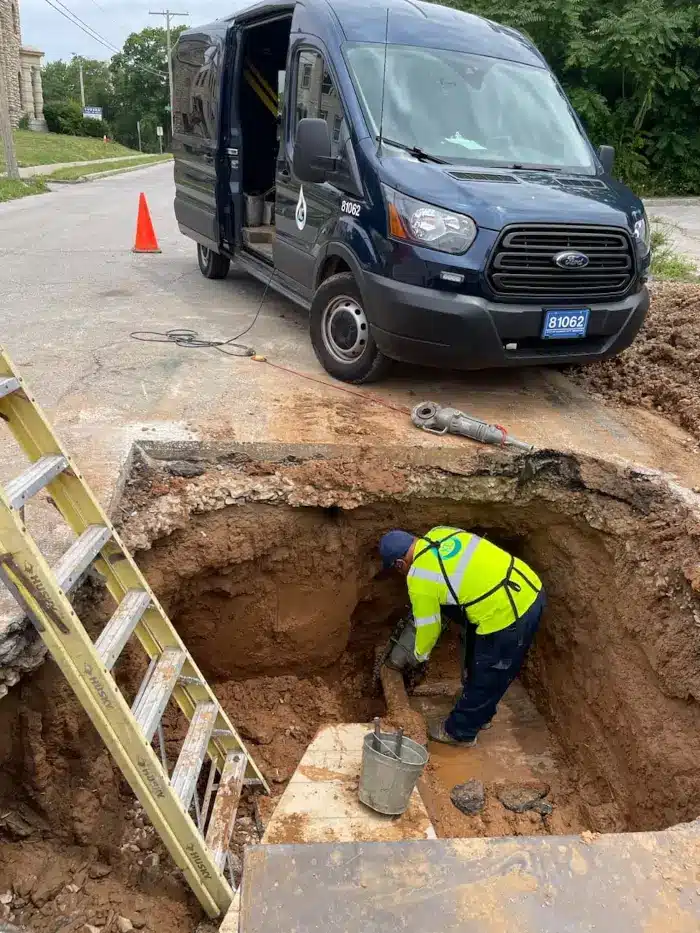
The water bill is the most reliable early warning. A water line leak runs every hour of every day, so a line that was steady for years and suddenly costs 20 to 40 percent more, with no new people, fixtures, or watering, is the classic signature of a hidden leak. Pull up a year-over-year comparison for the same month if your utility shows it.
Out in the yard, look for ground that stays soggy, sunken, or noticeably greener than the rest in dry weather, since escaping water feeds the grass above it like free irrigation. Inside, low pressure at several fixtures at once points to a water line leak emptying the pipe before it reaches the house, rather than one clogged aerator.
Watch for these red flags. One on its own is worth checking. Two or three together usually point to a water line leak.
| What you notice | What it usually means | Urgency |
|---|---|---|
| Water bill jumps, same usage | Water is escaping before it reaches the house | High |
| Low pressure at several fixtures | Less water is making it into the home | Med to high |
| Soggy or extra-green yard, no rain | Water is surfacing along the line path | Med to high |
| Water bubbling in the street or by the meter | A break is venting to the surface | Urgent |
| Running or hissing sound, everything off | Pressurized water is escaping somewhere | Med to high |
| Rusty or cloudy water at the tap | Aging, corroding pipe, often galvanized | Medium |
| New cracks or sunken spots in a driveway or slab | Water is washing out soil under hardscape | Urgent |
Low water pressure has more than one possible cause, so it is worth ruling out the easy ones before you assume the worst. If weak flow is your only symptom, start with the common causes of low water pressure and work from there, then come back to the water line leak checks if it persists.
Confirm a Water Line Leak Yourself: The Meter Test
You do not need any tools to confirm a water line leak. Your water meter does the work, even for an underground water leak you cannot see. This is the same test our crews walk homeowners through over the phone before we head out.
- Turn off every water fixture and appliance inside and outside, including the icemaker and any irrigation.
- Find your meter, usually in a covered box near the street or sidewalk, and lift the lid.
- Look at the leak indicator, the small triangle, star, or low-flow dial on the face. If it is spinning or creeping with everything off, water is moving through the meter.
- For a slow leak, write down the reading, wait 30 to 60 minutes without using water, then check again. Any change means a leak.
- To tell inside from underground, shut off your home’s main shutoff valve and watch the meter again. If it still moves, the leak is between the meter and the house, on your underground service line. If it stops, the leak is inside.
If your meter is digital, shine a light on it and watch for a flow rate above zero or a small flashing icon. If it is analog, the leak indicator is a tiny triangle or red dial that turns on the smallest flow. Cannot find the meter? It is usually in a covered box in the parkway near the street, and a long screwdriver helps pry up a stuck lid.
That isolation step is the one that matters most, because it separates a leak inside a wall from a dig in the yard. If you want to narrow it down further first, these simple ways to find a hidden water leak help you pinpoint a water line leak before you call.
What Causes Water Line Leaks in Kansas City
Most water line leaks in Kansas City trace back to a short list of local culprits. The metro’s older neighborhoods, its clay soil, and its hard freeze-thaw winters are all tough on buried pipe, and almost every water line leak we dig up fits one of these patterns.
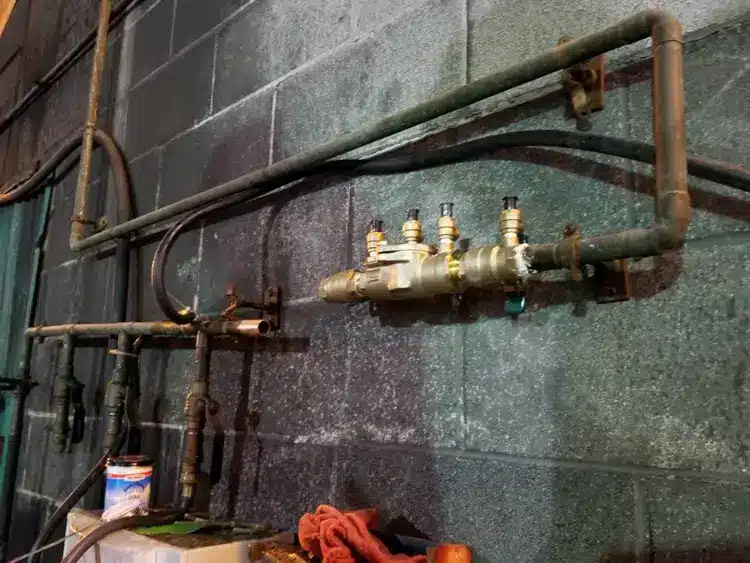
- Aging galvanized steel. KC’s early-1900s housing stock is full of galvanized service lines that corrode and scale from the inside. By the time a water line leak shows up, the inner diameter is often half what it started at, which is why pressure fades long before the break.
- Shifting clay soil. Kansas City’s heavy clay swells when wet and shrinks when dry, flexing the line at its joints. A broken water line in this ground often shows up right after a long dry spell or a heavy soaking rain.
- Tree roots. Roots chase the moisture around a pinhole and slowly pry the gap wider until you have a full water line leak.
- Freeze-thaw winters. Shallow or exposed lines, especially in unheated crawlspaces, can split during a hard Kansas City freeze.
- High water pressure. Steady pressure above about 80 psi strains every joint and fitting until one gives.
- Plain age and corrosion. Even copper develops pinhole leaks over decades, faster where the water sits acidic.
Kansas City stacks several of these at once. A galvanized line already thin from corrosion, set in clay that moves every season, under a city that swings from humid summers to hard freezes, does not need much of a push to spring a water line leak. That combination is why local service lines tend to fail earlier than the textbook lifespan suggests.
What Is Your Water Line Made Of, and Is It Safe?
Knowing what your line is made of tells you a lot about why you have a water line leak and whether the pipe is worth repairing or replacing. You can usually identify it yourself where the pipe enters the house, near the meter or the main shutoff valve.
Two quick checks do it. Hold a magnet to the pipe: if it sticks, you are looking at galvanized steel. If it does not, the line is copper, plastic, or, in rare cases, lead. Then gently scratch the surface with a coin. Copper shows a bright penny color, galvanized stays a dull gray, and lead turns a soft shiny silver.
| Material | How to spot it | Typical lifespan | Notes |
|---|---|---|---|
| Galvanized steel | Magnet sticks; dull gray; scratch stays gray | 40 to 70 yrs, often less | Scales and corrodes from inside; common in older KC homes |
| Copper | No magnet; scratch shows bright penny color | 50+ yrs | Durable; can develop pinholes with age or acidic water |
| PEX (plastic) | Flexible; red or blue; no magnet | 50+ yrs | Modern, freeze-resistant; common on new installs |
| PVC (plastic) | Rigid white or blue; no magnet | 50+ yrs | Used on some service lines and most drains |
| Lead (rare) | No magnet; scratch shows shiny silver; soft | Replace | Banned in MO since 1989; none confirmed in KC so far |
Kansas City has been cataloging all of this. After reviewing more than 178,000 service lines, KC Water reported zero confirmed lead lines, roughly 23,000 galvanized lines, and about 25,000 still unidentified. Lead was banned for water lines in Missouri back in 1989, and KC Water treats the supply with lime softening and added phosphates that limit metals from leaching into your water. You can look up your own address on the KC Water Service Line Inventory to see what the city has on record for both the public and private sides of your line.
If your line came back as unknown on the city’s map, that simply means there is no record, not that something is wrong, and the self-reporting tool lets you log what you find. If it is galvanized, copper and PEX are the usual upgrades. Both deliver full, steady pressure and shrug off the corrosion that eats steel from the inside.
If your line is galvanized, that is mostly a flow and reliability concern rather than a health scare. Galvanized pipe can hold and release lead only when it sits downstream of a lead source, and so far Kansas City has confirmed none. Still, a corroding line that keeps springing a water line leak is worth replacing on its own merits.
Not sure whether that wet spot is a water line leak or the city’s line? A quick on-site check settles it and tells you exactly what the fix involves.
What to Expect When a Plumber Comes Out
A good water line leak visit starts with diagnosis, not a shovel. We confirm the leak with a pressure test, then locate it with acoustic equipment or a line locator so the dig lands right on the failure instead of guessing across the yard. That single step saves homeowners from a trench they never needed.
From there you get options in plain language: a spot repair if the line is otherwise sound, or a replacement if it is galvanized or failing in more than one place. We explain the method, the likely timeline, and the restoration before any work starts, so the plan and the price are clear up front.
Repair or Replace, and What Drives the Cost
Not every water line leak calls for a full replacement. The right move depends on the pipe’s material, its age, and how much of the line has actually failed.
A spot repair makes sense when a water line leak is a single, accessible failure on an otherwise sound copper or PEX line. We expose that section, fix it, and backfill, often a small dig and a same-day job.
Replacement makes more sense when the line is aging galvanized, because patching one water line leak just moves the next failure a few feet down the pipe. The same is true when there are several leaks, or when a repair would run more than about half the cost of replacing the whole line.
How it gets done matters too. An open trench is straightforward but tears up whatever sits above the line. Trenchless methods renew the line with little digging, which protects lawns, driveways, and mature trees. John the Plumber uses trenchless options, including the family’s own Hydrosion boring, to handle water line replacement with minimal surface damage.
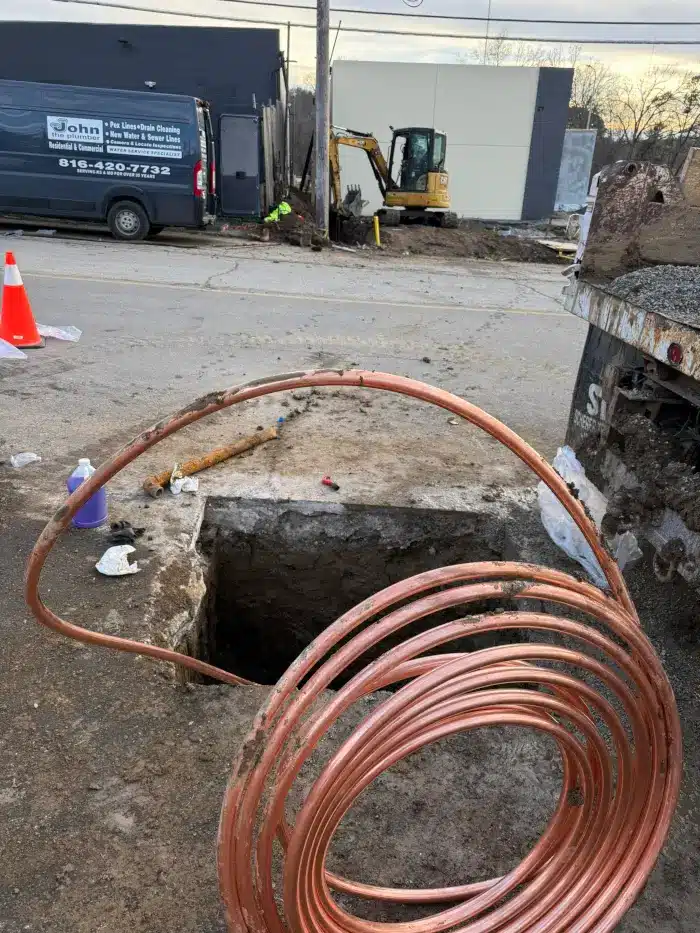
Timelines vary with method. A trenchless replacement on a clear run often wraps in a day, while an open-trench job, especially under a driveway or in deep, rocky ground, can take two to several days with restoration after. Length, depth, and access drive both the schedule and the price more than anything else.
Here is what fixing a water line leak typically runs for the private side of the line in 2026. Your number depends on length, depth, soil, access, and method, so treat these as ballpark ranges rather than a quote.
| Work | Typical range | Notes |
|---|---|---|
| Locate and small spot repair | $300 to $1,500 | One accessible leak on an otherwise sound line |
| Trenchless replacement | $3,200 to $8,000 | Boring or pipe bursting, minimal yard damage |
| Open-trench replacement | $5,000 to $16,000+ | More restoration; depends on length and depth |
| Per linear foot (replacement) | $75 to $250 | Varies by method, depth, and access |
| Emergency or after-hours | Add 25% to 50% | Burst line or total loss of water |
A few extras can move the total. A permit, a new main shutoff valve, or a pressure-reducing valve each add a few hundred dollars, and restoring a driveway or sidewalk adds more. The only way to know your real figure is an on-site look, which is why we give a clear quote and our full water line repair options before anyone starts digging.
What to Do Right Now If Your Water Line Is Leaking
If you are fairly sure you have a water line leak, move quickly. A slow leak quietly wastes water and undermines soil, while a burst main floods fast. A few steps protect your home and your wallet.
- Shut off your main water valve to stop the flow and limit damage.
- Do not start digging on your own. Gas, electric, and other utilities run underground nearby, so in Missouri call 811 first and let the lines get marked.
- Take a few photos and note when the trouble started. If you carry service-line coverage, this supports a claim.
- Call a licensed plumber. Standard homeowner policies often exclude wear-and-tear pipe failures, so the repair is usually out of pocket unless you added service-line protection.
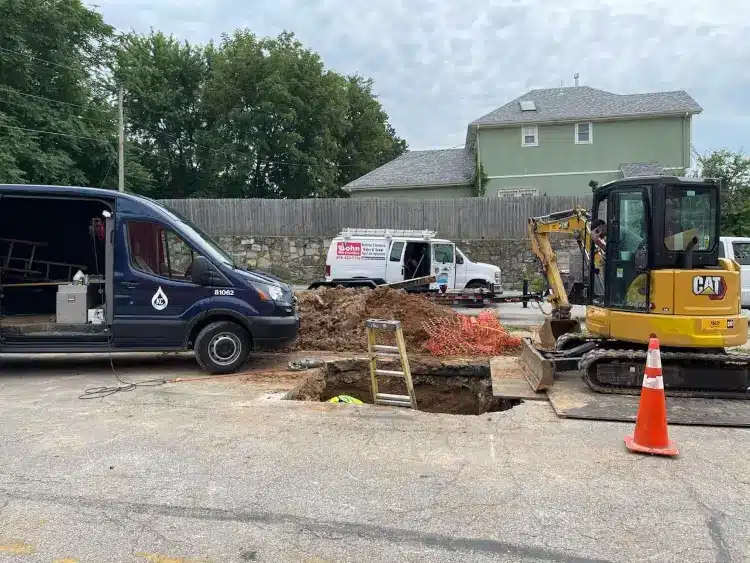
When you call, have a few things ready: where the water is showing, what your meter is doing, and the rough age of the house or line if you know it. That helps us bring the right equipment on the first trip. For a fast response anywhere in the metro, our emergency plumbers near you can locate the water line leak, confirm which side of the curb stop it is on, and lay out your options the same visit.
Can You Prevent the Next Water Line Leak?
You cannot prevent every water line leak, but you can stack the odds. The biggest lever in Kansas City is pressure. If your static pressure runs above 80 psi, a pressure-reducing valve takes constant strain off every joint and fitting in the system.
A few habits help too. Keep large trees and aggressive shrubs off the line’s path, since roots find and widen any weak spot. If your home still runs galvanized, plan to replace it before it fails on its own schedule rather than during a holiday freeze. And know where your main shutoff is, so the day a water line leak does start, you can stop the water in seconds instead of minutes.
Water Line Help Across the Kansas City Metro
A water line leak is stressful, but it is routine work for a crew that handles it every week. John the Plumber has worked Kansas City water lines for more than 30 years on both the Missouri and Kansas sides of the metro, from a single pinhole on a copper line to a full galvanized replacement. You can see everything we cover on our water line services page.
Where the layout allows, we use trenchless methods to renew the line with little digging, so your lawn, driveway, and walkways stay intact. And if slow drains or backups turn up at the same time, the same crew handles sewer line work underground without a second mobilization.
When you are comparing options, look past the cheapest bid. The right crew brings real diagnostics, upfront pricing, dual-state licensing for both the Missouri and Kansas sides, and trenchless capability so a fixable leak does not become a wrecked yard. That is the standard owner John Hunt holds every job to.
Think You Have a Water Line Leak?
Catch it early and you keep a small leak from becoming a burst main, a washed-out yard, or a runaway bill. John the Plumber locates and fixes Kansas City water lines every week, with trenchless options that spare your lawn and driveway.
Water Line Leak FAQs for Kansas City Homeowners
Still have questions about that wet spot, the meter test, or who pays for the fix? These are the questions Kansas City homeowners ask us most about a water line leak, with straight answers grounded in local pipe, soil, and the way the city splits ownership at the curb stop.
How do I check my water meter to confirm a leak?
Turn off every fixture and appliance inside and out, then watch the meter’s leak indicator, the small triangle or low-flow dial. If it moves with all water off, you have a leak. Shut your main valve and recheck. If it still moves, the leak is on your underground service line, not inside the house.
Who is responsible for the water line, me or the City of Kansas City?
In Kansas City, KC Water owns the line from the main to the curb stop, and you own the private service line from the curb stop to your house. A leak on your side is yours to repair and pay for. If water surfaces between the sidewalk and street, confirm which side it is on before assuming it is the city’s.
Does homeowners insurance cover a water line leak or replacement?
Often not. Standard homeowner policies usually exclude gradual wear-and-tear pipe failures, which is what most underground leaks are. Some insurers sell separate service-line coverage that helps with the buried line from the curb to your house. Check your policy, and photograph the damage if you plan to file a claim.
How can I tell what my water line is made of?
Check where the pipe enters near the meter or main shutoff. Hold a magnet to it. If it sticks, it is galvanized steel. If not, scratch it with a coin. Copper shows a bright penny color, lead turns shiny silver, and plastic lines like PEX or PVC will not attract a magnet at all.
Is a water line leak an emergency, or can it wait?
It depends on the flow. Water bubbling up, flooding, or a total loss of pressure is an emergency. Shut your main valve and call right away. A slow leak showing only as a higher bill or a damp spot is not an instant crisis, but it wastes water and worsens, so do not let it sit for weeks.
Can I find or fix a water line leak myself?
You can often confirm and roughly locate a leak yourself with the meter test, which saves time on the call. Fixing a buried service line is another matter. It needs permits, utility locates, and the right equipment, and a wrong cut can hit a gas or power line. Locating is DIY-friendly. The repair is not.
Could a leaking or galvanized water line affect my drinking water?
Usually it is a flow and reliability issue more than a health one. Galvanized pipe can release lead only when downstream of a lead source, and KC Water has confirmed no lead lines so far while treating the supply to limit leaching. Still, a corroding line that keeps leaking is worth replacing.